
Build Update 2: Prepping Driveway & Slab Sites
Getting the site ready for the first two buildings.

If you remember from the last post, last I’d left the property we’d done some clearing and started to prepare for building.
The site plan looked like this:
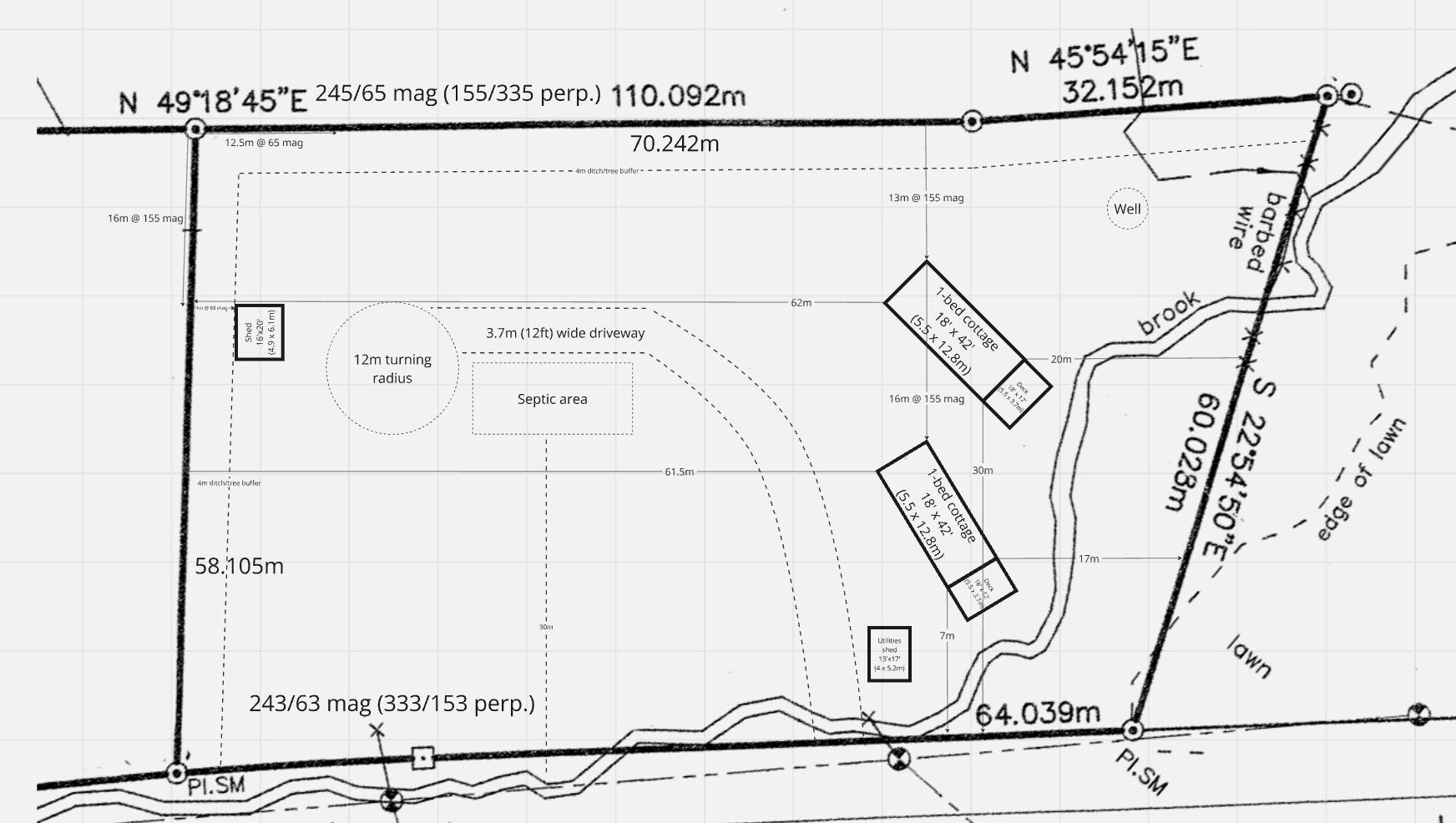
The steps before building looked something like:
Get excavator on the property to ditch the top and left sides (dotted line on the plan above)
Get driveway put in
Get gravel pads for power shed and larger shed placed, levelled, and compacted
Ditching
In the top corner (top left on site plan above) of the neighbouring property, the previous owner had put a brush pile, intending to burn it, but never getting around to it.
That pile had grown over the years, and had water drainage (a small stream at times) flowing around this pile.
The result was that water would be spread out over our property, making much of it mucky and wet through the spring and fall, only really drying out in the peak of summer.
The neighbouring property generally drains down onto our property as well, which compounded the issue.
So the first order of business was to get a ditch around the sides of the property to keep the water off.
Doing this in the spring proved a challenge, and I was surprised to show up one day to watch the excavator work, only to find the treads fully immersed in mud!


After a couple days (spaced over several weeks), the excavator had done its work, and water was flowing freely through the ditch.
The neighbours also took me up on the offer to have the excavator flatten the brush/dirt pile on their property, which helped immensely, and removed an eyesore from their yard.
This work was finished through April/May, and though it was diverting a lot of water, it wouldn’t be until late June/early July that the property really dried out.
Partly this is due to the amount of brush still on the property, but I’m sure there will be more work in my future removing low spots and adding drainage.
This is something we knew when purchasing the property, and the upside is that we aren’t worried about good water supply.
Driveway
The driveway was a necessity before the shed in the back of the property could go in, as the heavy equipment needed to get back there to flatten the gravel pad, and then to pour concrete. It made delivering materials next to the build site much easier as well.
Unfortunately, the contractors came to build the driveway on the one week I was away in Montreal, which meant I was attempting to describe over the phone where it should go. I texted them photos of my drawn plans (which I’d prepared beforehand), but the terrible service on the property also made that difficult.
Either way, they got it done not far from where I’d imagined it, and the route they took meant far fewer trees needed to be taken down, which is a good thing.
It also made me realize the vertical change in the property near the back shed, which may mean I need to adjust some plans.


The driveway consisted mostly of 4-6” rocks, which makes it a bit rough overall, and it will need some finer gravel later. But for now it does the trick.
Gravel Pads
According to the FastSlab instructions, the gravel pads on which the slab forms get placed should be 4-6” of 3/4”-1” gravel, with 1-2” of crusher dust on top.
At the advice of my contractor, I didn’t bother with the crusher dust, and instead just left the pads as they’d created them.
Thankfully, they’d actually rolled them with a steamroller when they were building the driveway, so I basically had to do nothing. They weren’t perfectly flat, and I just eyeballed the raking when I was doing final preparations.
Turns out it was good they did roll them, because getting a compactor to each site is not trivial. You can rent them from building supply stores, but that’s not the difficult bit.
Light compactors still weigh something like 250lbs. A friend of mine has two, and offered them to me, and the light one was 250lbs while the heavy one was 800lbs. He moves them around with a skid steer, which he hauls behind a big truck on a trailer when he’s doing jobs (he’s a hardscape).
Even a 250lb compactor is a significant thing to try and move around, and I’m still not quite sure how I would have done it. Probably with a combination of a hand truck and some ramps, or perhaps a set of the moving straps meant for two people. Either way it’s a significant undertaking and would likely have delayed me a few days.
At this point, the driveway is in, which means concrete trucks can get to both slab sites, and the slab sites are ready for concrete forms and then pouring.